
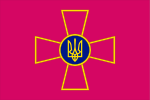
- Service ensign · official · carried by Armed Forces of Ukraine
- State affiliation · Ukraine
- Vigil category device · not official insignia
Identity provenance
Service ensign: Ensign of the Armed Forces of Ukraine — carried by Armed Forces of Ukraine, not issued to this record. The ensign of the Armed Forces of Ukraine. The design itself is excluded from copyright by Article 8 of Ukraine’s Law on Copyright and Related Rights, which names symbols and signs of government authorities, the Armed Forces of Ukraine and other military formations. The file shipped is the Wikimedia Commons SVG "Ensign of the Ukrainian Armed Forces.svg", released under PD-UA-exempt on that basis, so no attribution or share-alike obligation attaches. Optimised for web display; geometry unaltered.
State affiliation: Ukraine.
The smaller square mark is a Vigil category device, drawn from this record’s own domain, echelon and role — not an official insignia.
In brief
The military-medical branch — casualty evacuation and treatment at a scale Europe has not seen since 1945.
- Scope
- Structure, role, lineage and links. 8 subordinate records published.
- Subordination
- Subordination confirmed
- Sources
- 3 on the record
- Record state
- Partial
Broad area of activity
A national evacuation chain: stabilisation near the line, regional military medical clinical centres in six cities, and onward treatment abroad.
Notable history
Reorganised in February 2020 out of the Main Military Medical Directorate into a branch with its own command, and then required to run the largest sustained casualty-evacuation problem a European army has faced since the Second World War. Its shape is regional rather than tactical: a national centre in Kyiv and five regional military medical clinical centres — Lviv, Odesa, Kharkiv, Dnipro and Vinnytsia — with numbered mobile hospitals providing deployable surgical capacity between the front and the rear, and the Ukrainian Military Medical Academy training into all of it. Its practices have been revised continuously under fire, and are now studied by the NATO medical services that once taught them.
Strengths
A regional structure that keeps large fixed hospitals outside the reach of most strike systems while staying connected to the front by road and rail; deployable surgical capacity that moves with the axis of effort; more accumulated experience of high-volume blast and drone-strike casualties than any other European medical service.
Limitations
Evacuation times are governed by drone observation over the rear rather than by medical capacity, which is the constraint no amount of structure solves; staffing and rehabilitation capacity lag the casualty load; and the branch carries a burden — prosthetics, rehabilitation, mental health — whose scale outlasts the war and which no order of battle records.
Subordinate formations
Centres 6
National Military Medical Clinical CentreCentre · subordination reportedMilitary Medical Clinical Centre — Western RegionCentre · subordination reportedMilitary Medical Clinical Centre — Southern RegionCentre · subordination reportedMilitary Medical Clinical Centre — Northern RegionCentre · subordination reportedMilitary Medical Clinical Centre — Eastern RegionCentre · subordination reportedMilitary Medical Clinical Centre — Central RegionCentre · subordination reportedInstitutions 2
Military mobile hospitalsInstitution · subordination reportedUkrainian Military Medical AcademyInstitution · subordination reportedRows are layout only — position and order carry no hierarchy, importance, sequence or strength. Every record shown is an immediate subordinate of the selected organisation. Headings are derived from each record’s own type and echelon. They are not command layers, and no such layer exists in the force tree.
Lineage & institutional history
Assessed as of2026-09Last reviewed2026-09
See this force in the structure Interactive: select this record and follow what connects to it.