Read
Briefs & analysis
Follow what changed and what it means through Weekly Briefs and Analytical Notes.
Context. Not headlines.
Vigil connects current developments to the actors, institutions, forces, geography and pressures that shape what happens next.
Read the latest analysis, explore conflict systems, or start from geography.
Briefs & analysis
Follow what changed and what it means through Weekly Briefs and Analytical Notes.
Systems & actors
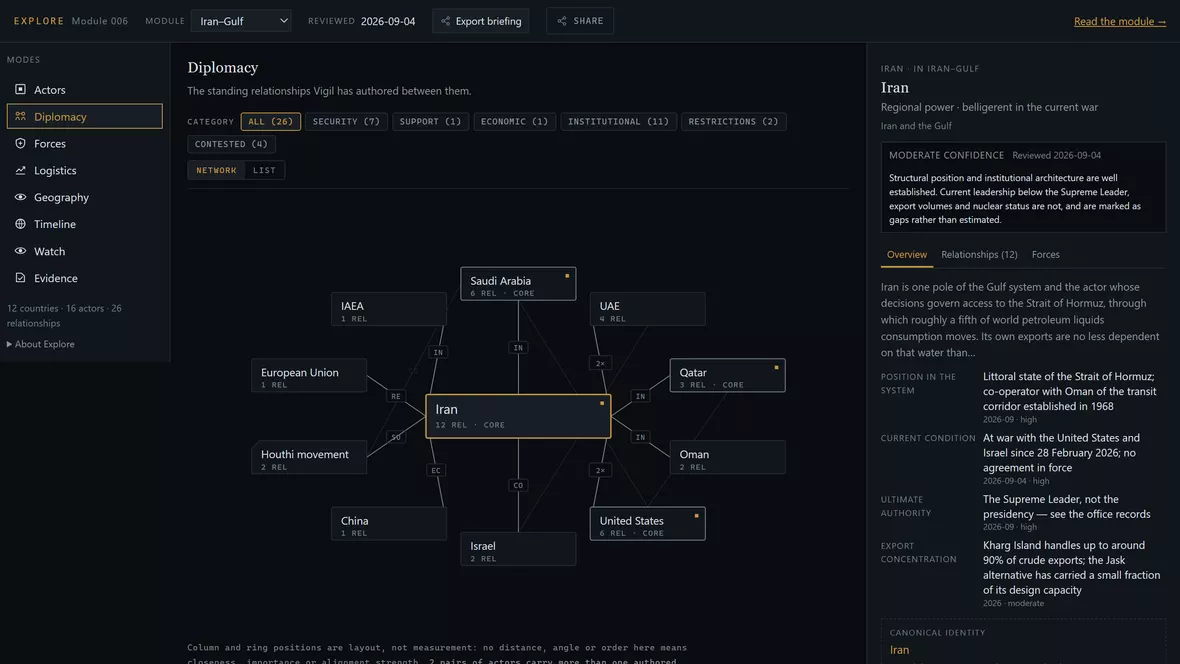
Work through conflicts using connected maps, actors, forces, logistics, campaigns, assessments and observables.
Geography & infrastructure
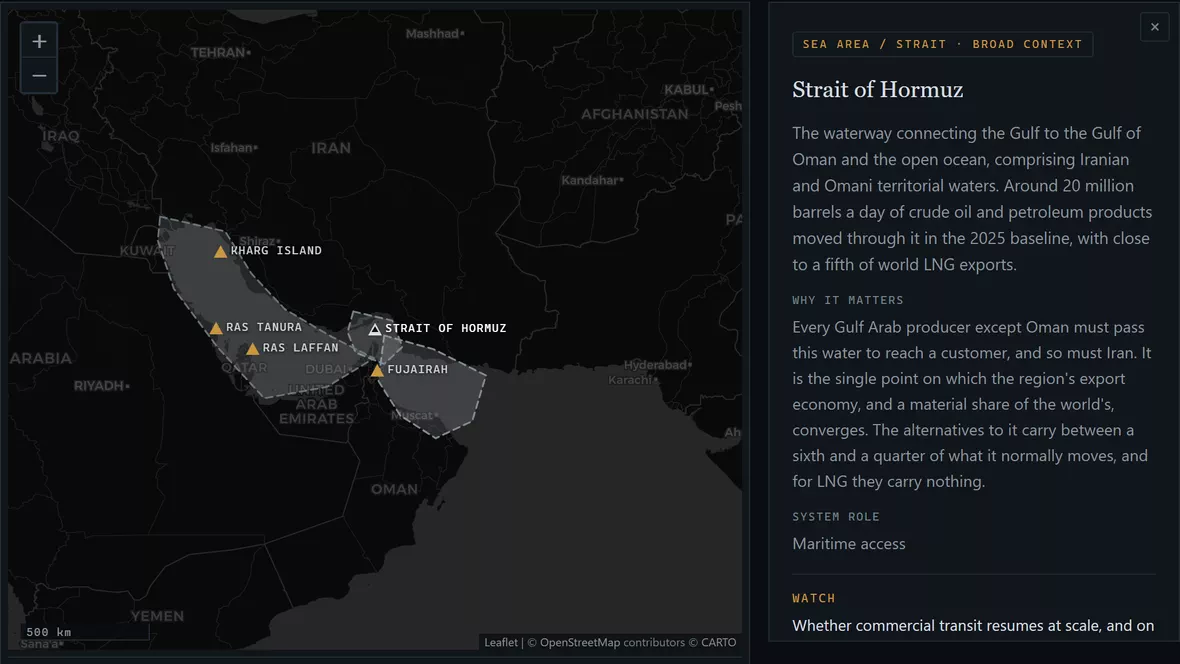
Map basis — authored sea areas + located infrastructure · not routes or activity
Start with place. Examine the geography, infrastructure and spatial constraints shaping each conflict.
How a waterway becomes unusable while staying navigable — and why the distinction outlasts this war
Key judgment
On 28 February 2026 Iran declared the Strait of Hormuz closed. The strait was not closed. It has never been sealed, no party has physically blocked it, and ships that wanted to sail could. What stopped them, a week later, was that protection-and-indemnity clubs stopped writing war-risk cover — and a vessel without cover does not sail, because no charterer will load it and no bank will finance it. Commercial transits fell by more than 80% through a waterway nobody had closed. This note separates three things routinely collapsed into one — legal access, physical access and commercial access — and argues that the third is the one that decided the outcome. The bypass pipelines are real and insufficient; liquefied gas has no bypass at all; and a legal claim over a strait produced no control over it. The mechanism is not new: the Security Council reached back to 1984 to cite itself.
GLOBAL WEEKLY REVIEW · published 2026-09-06 · reporting window 2026-08-31 → 2026-09-06. The full brief carries every item, its sources and its confidence note.
This is the first reciprocal military restraint the two governments have coordinated in this negotiating track, and its shape is more informative than its existence.
In two weeks Damascus has seen its two autonomy files move in opposite directions, and the contrast is the finding. In the northeast an armed movement exchanged institutional standing for appointments inside the state — a dispute about the terms of entry, settled by entering.
For two years this file has been assessed against an instrument that does not exist. This is the first jointly published account of what the two governments say the process has produced instead, and the content is commercial rather than legal: fuel moving one way, grain the other, commissions sitting, a route being surveyed.
Also reviewed this weekSahel — no material changeTaiwan Strait
Vigil Dispatch
Get Vigil’s Weekly Briefs and new Analytical Notes by email.
One confirmation email, then Weekly Briefs and new Analytical Notes. Unsubscribe at any time.
All six published modules are reviewed every week. Each receives a dated weekly brief; quiet weeks explicitly record when no material change was identified.
An interstate war reshaping European security.
One conflict system across three states, with no single front.
Unresolved wars inside a changing regional system.
A civil-war legacy shaping a regional transition.
A pressure system where deterrence, not fighting, is the subject.
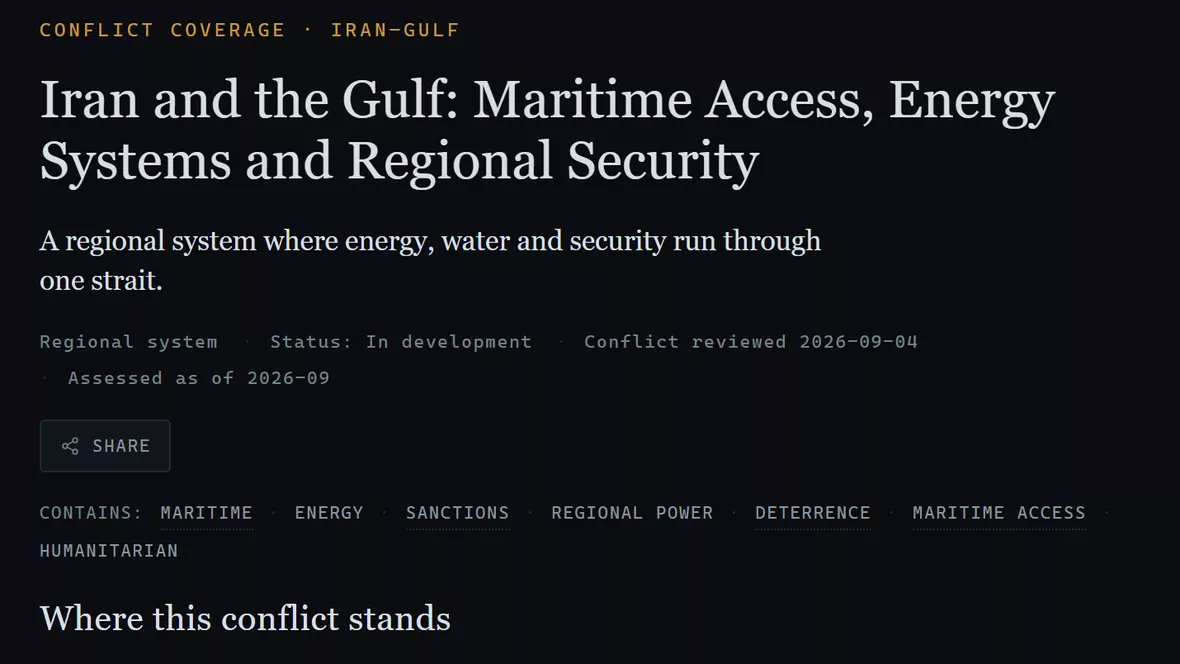
A regional system where energy, water and security run through one strait.
Every active conflict is reviewed on a weekly cycle and the findings are published as a dated brief — including the weeks where the finding is that nothing material changed.
Each finding is linked back to the actors, forces, geography, institutions and economic channels the conflict already runs through, so a development is read against the system rather than on its own.
Sources, publication and review dates, confidence grades and stated information gaps travel with the claim — including where Vigil does not know.
The full method — grading, dating, sourcing and correction — is set out in the methodology.
Every published finding cites the reporting behind it.
High, moderate or low — with a note saying what the grade rests on.
Publication, assessment and review dates are distinct and all shown.
Errors are recorded and dated rather than quietly edited away.
No current positions, strengths, movements or targeting detail — those have no fields in Vigil’s schemas.
Each conflict is reviewed weekly; quiet weeks say so explicitly.